Early validation of the core MIEYRA architecture, demonstrated in hardware rather than simulation.
The core MIEYRA architecture has now been demonstrated in operational NIR hardware. The platform is capturing high-quality raw spectra from real materials and providing a practical evaluation system for partner testing, while Raman, MIR and multimodal variants progress through development.
Raman, NIR and MIR each interact with molecules differently and provide complementary information. Raman can provide highly specific molecular fingerprints, while NIR and MIR capture absorption signatures that may be weak or inaccessible through Raman alone.
Combining these modalities has the potential to increase measurement confidence, broaden the range of detectable substances and improve performance in complex real-world environments.
Rather than depending on a single spectral signature, MIEYRA is being developed to combine complementary molecular information within one sensing platform.
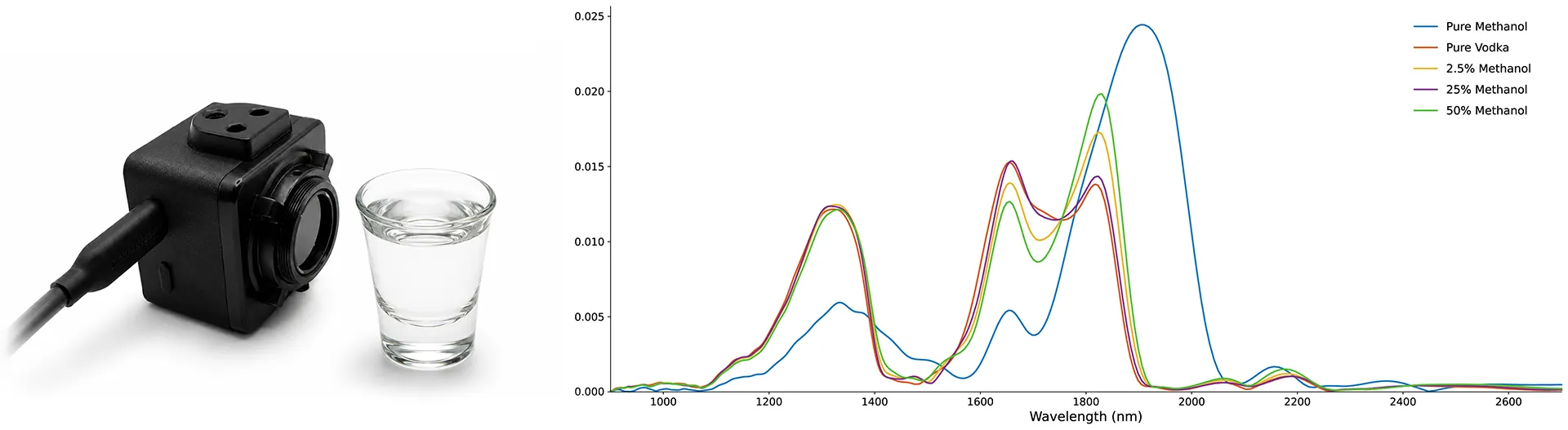
Methanol poisoning of vodka, detected across multiple concentrations — 2.5%, 25% and 50% (raw spectral data).
The test demonstrates the platform’s ability to distinguish spectral changes associated with contamination in a real-world liquid sample, supporting future personal-safety and substance-identification applications.
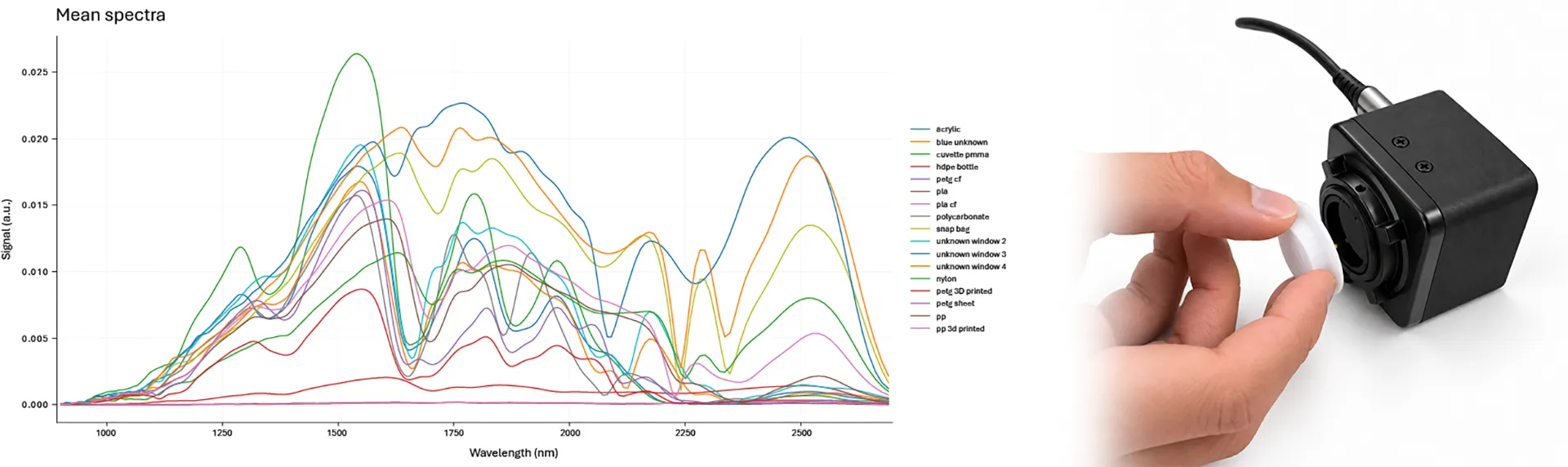
Raw spectral data captured from automotive engineering polymers using the MIEYRA NIR beta platform.
The trial demonstrates clear spectral differentiation between real-world polymer samples, supporting future applications in materials verification, manufacturing quality control, recycling and autonomous inspection.
The semiconductor-scale sensing core at the heart of the platform.
Operational evaluation hardware for spectroscopy development, application testing and partner programmes.
High-quality spectra captured from real-world materials.
Operational NIR hardware has demonstrated the core semiconductor architecture. The next stage extends this architecture across Raman, MIR and multimodal sensing, moving from individual modalities towards compact systems capable of combining complementary molecular information.
Raman and MIR evaluation platforms are targeted for 2027, followed by increasingly integrated multimodal architectures, including sensing modalities combined on a single silicon die.
The long-term objective is a common semiconductor platform capable of bringing molecular sensing into wearables, autonomous systems, industrial equipment and other mass-market devices.

We work with organisations exploring the next generation of intelligent products, wearable technologies, defence systems and sensing platforms.
John represents SCVC (Science Creates Venture Capital) on the PhovIR board. A serial entrepreneur and investor, John is best known as the founder of Kudan, one of the early pioneers in Physical AI and machine perception. Having built and scaled a publicly listed deep-tech company, he brings valuable expertise in venture growth, capital formation, commercialisation, and international expansion.
Khadija Ashfaq is an Investment Director at Northern Gritstone, a leading investor in university spinouts and deep-tech businesses across the North of England. Representing Northern Gritstone on the PhovIR board, she brings extensive experience in evaluating and scaling science-led companies across semiconductors, AI, quantum technologies, and advanced engineering, providing strategic guidance on growth, investment, and commercialisation.
Tim is Founder and CTO of PhovIR Technologies and inventor of the company’s proprietary MIEYRA sensing platform. Combining over 20 years of experience in photonics, semiconductor technologies, MEMS, and advanced materials, Tim brings a rare blend of deep scientific expertise and commercial technology development experience. His career includes roles at Bosch and IMEC, alongside internationally recognised research leadership, providing the foundation for PhovIR’s next generation of optical sensing technologies.
Tim holds a PhD in Engineering from the University of Cambridge and a degree in Electrical Engineering from RWTH Aachen University.
Ben is Chief Executive Officer of PhovIR Technologies and a deep-tech executive with more than 20 years of experience scaling businesses in photonics, advanced materials, and semiconductor technologies.
Prior to PhovIR, Ben led multiple deep-tech companies, including 2D Photonics, where he was responsible for founding, strategy, fundraising, and commercialisation. Across his career, he has helped secure over €250 million in venture investment and government funding.
Ben founded Surrey NanoSystems and led the invention and commercialisation of the globally recognised Vantablack® technology platform. He has built international manufacturing and supply chains across China, Vietnam, and Mexico for automotive applications, alongside technology programmes supporting space and defence markets in Europe and the United States.
An inventor or co-inventor on 28 patents, Ben leads PhovIR’s corporate strategy, investment activities, partnerships, and product commercialisation as the company develops the next generation of optical sensing technologies.